
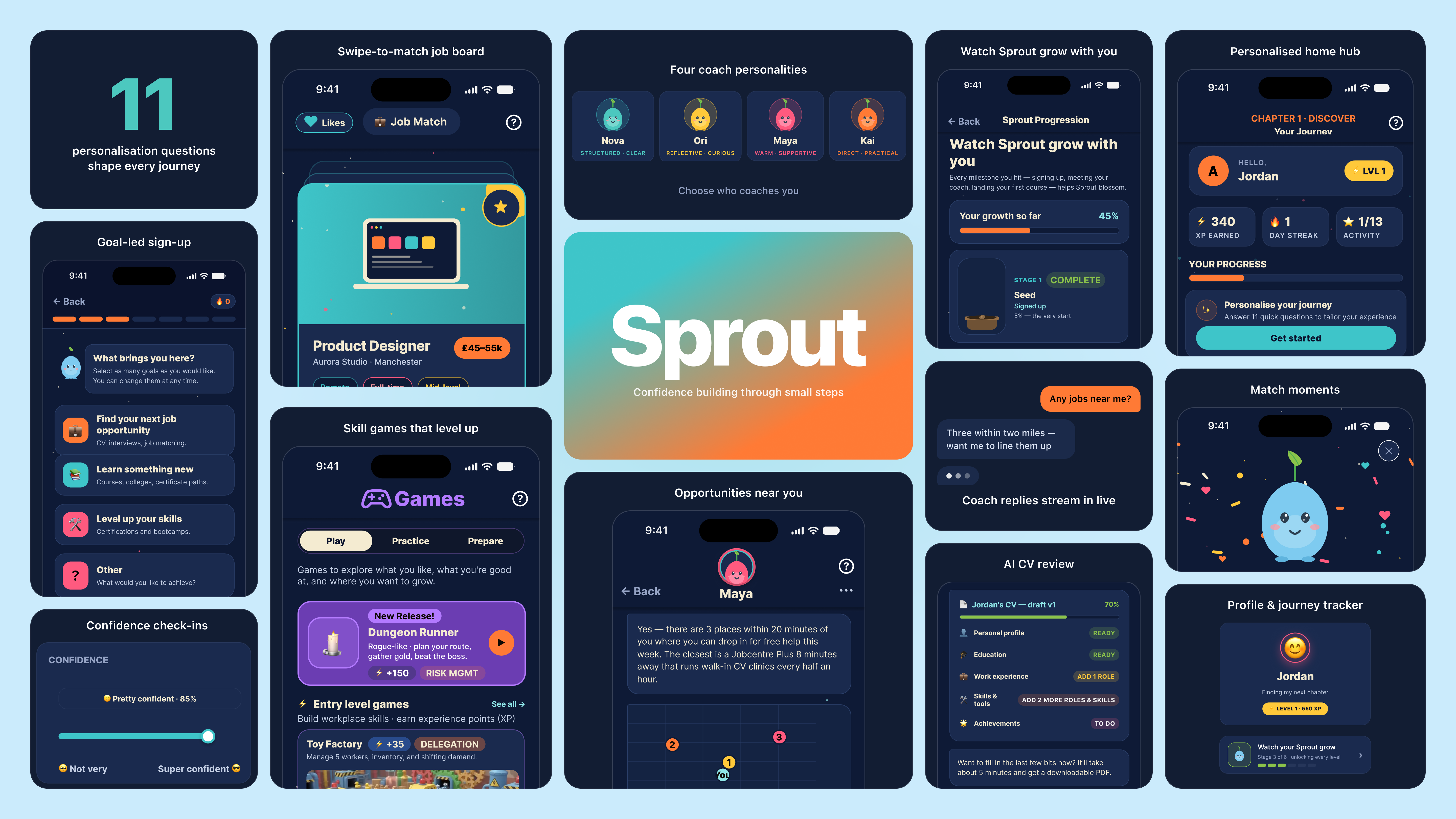
Sprout
Prototype · Mobile App · Public ServiceSprout helps 18-24 year olds who are not in education, employment, or training (NEET) build confidence through small, achievable steps towards their next opportunity. Designed on an IBM internship with a UK government department.
TL;DR
- 12-week IBM Summer Internship (2026) with a UK government department as the client, designing a confidence-building app for 18-24 year olds not in education, employment, or training (NEET), including "hidden NEETs" who aren't claiming Universal Credit or any other support
- Primary research: jobcentre and youth hub observations, frontline-staff and student interviews, and a NEET survey, synthesised into seven personas and journey maps
- Usability tested with 9 young people and 2 work coaches across two rounds; every critical issue found was fixed
- Chose the approach to solve with the client, ran weekly playbacks, and delivered a full Figma prototype
- Presented the work to the Government Digital Service (GDS), the Department for Science, Innovation and Technology (DSIT), and Andrew Western, Minister for Employment
Challenge
Reaching young people the system struggles to support
NEET young people fall out of the system in different ways - some cycle between job applications and rejection, some are held back by health or circumstance, and some never appear in the department's data at all because they aren't claiming Universal Credit or any other support, making them effectively "hidden." An estimated 300,000 of these "hidden" NEETs sit outside traditional support channels entirely.
What young people told us:
"I have never heard of them. Professional and government? Is it something to do with pensions?"
The system was failing them in four ways
Health
45% of NEET young people report a disability, more than double the 2013/14 figure, and mental health is now the most common reason. Support sits in silos across health, welfare and education.
Systemic barriers
Fewer entry-level roles, less exposure to training, and shrinking work experience, while most "junior" jobs now ask for experience the person doesn't have yet.
Education
67% of students feel school did not prepare them for work. Weak links between education and support services, and little training on AI or applications.
Perception of the department
Young people saw jobcentre support as generic and compliance-led, felt the stigma carried over from the benefits system, and actively avoided being associated with it.
Desk research into the Milburn Report reinforced a common thread: participation should be treated as a gradual process, not immediate employment readiness, yet current systems lean on binary "fit for work" categories - 93% of Fit Notes reviewed assessed people as not fit for work, leaving little room for confidence-building. A Microsoft Forms survey found 67% of NEET individuals already use AI tools for CV writing and interview prep, yet the biggest difficulty remained the same: finding the right opportunities in the first place.
Persona research surfaced Jordan Mills, 18, part of the "COVID generation." He passed his GCSEs but dropped out of college, and has spent the time since financially supported by his parents rather than the state. His days are unstructured, his sleep is poor, and his social contact is minimal.
"Everyone expects you to have so much experience and I don't know how to get it."
Research into Jordan's journey surfaced recurring themes:
- Requirements are the blocker, not motivation - qualifications and CV questions stop people before they start
- Onboarding is the highest-risk moment: the first thing he can fail at, and he relies on his parents' safety net rather than risk it
- Aspirations are vague and undefined - he seeks stability and connection more than a named job
- Heavy gaming and social media use, but minimal real-world confidence or structure
Confidence is the biggest barrier, and it is the one the system rarely addresses. 61% of 15 to 18 year olds worry about finding work.
Direction
From a pile of pain points to one problem
We surfaced far more problems than a 12-week internship could solve. Working with the client, we picked the one with the most leverage and the least attention: confidence building through small steps.
Young people who feel overwhelmed or disengaged from opportunities
Taking small, manageable steps towards work, training and learning at their own pace
So they can rebuild confidence and motivation without fear of failure or judgement, through a safe, warm interface that tracks their progress
The vision
A world where every young person feels comfortable looking for help, knows where to go, and actually gets it. Five principles guided every decision:
- Well-being is the pathway to employment - progress starts with feeling able, not with being declared "job ready"
- Personalised support transforms outcomes - one generic route loses people who all start from different places
- Accessible, visible, youth-centred spaces - help has to meet young people where they already are
- Face-to-face effectiveness - what people valued most was a real person, so the product points towards one rather than replacing it
- Technology, leveraged correctly - used to lower the barrier to a first step, not to add another screening layer
Why it is worth building
Clarify routes to support
Young people can't use help they don't know exists
Make the department's role and the help available easy to understand
Engage the 300,000 hidden NEETs
Reach young people outside traditional channels
Let people search and progress at their own pace, independently
Build essential skills through personalised support
Confidence grows from small, manageable wins
Improve confidence and the overall experience of looking for work
Intervene earlier
Long-term inactivity is far more expensive than early support
Reach young people before they disengage, reducing long-term cost to the state
One young person who starts is one step further from long-term economic inactivity, and one less cost to the state later.
Research & Personas
Seven personas, seven routes into NEET
Desk research, jobcentre and youth hub observations, and interviews with frontline staff and students were synthesised into seven personas - each representing a different route into becoming NEET, and a different bar the app would need to clear to earn their trust.
Jordan Mills, 18
Hidden NEET
"COVID generation," financially supported by his parents, not claiming any support at all.
Aaron Lopez, 19
Transition NEET
Aspiring apprentice frustrated his school only ever pointed him towards university.
Georgia Green, 19
Discouraged NEET
Stopped applying after repeated silence from employers left her feeling judged.
Helena Mendez, 22
Health-Limited NEET
Neurodivergent (ADHD, anxiety, autism) - re-entering any system feels like an enormous hurdle.
Josh Allen, 20
Physically Disabled NEET
Wheelchair user frustrated that advice always assumes he can "just go to the Job Centre."
Olivia Green, 18
Care Leaver
Homeless after leaving foster care, navigating adulthood with no family safety net.
Saif White, 23
Job-Seeking NEET
Disengaged graduate stuck between being overqualified and underexperienced.
Spotlight: Jordan Mills
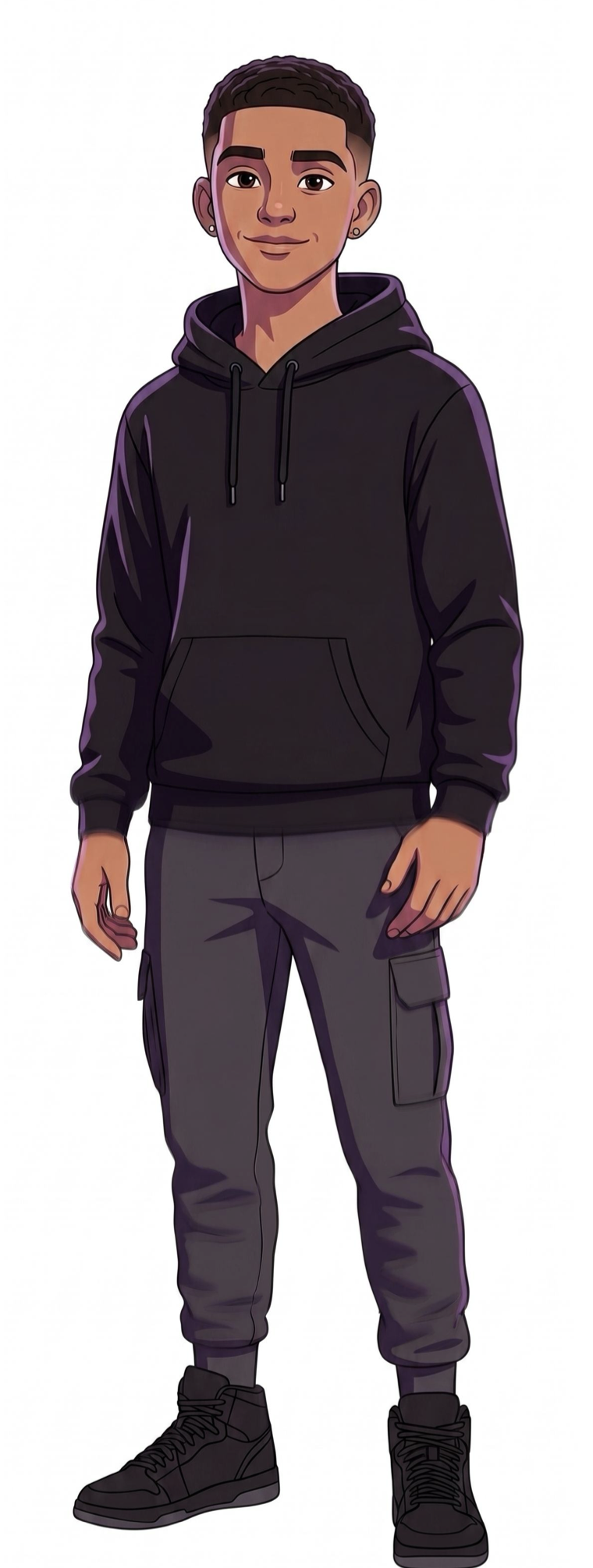
Jordan, the hidden NEET, became the flagship persona. His profile summarises what he needs from the app, and the research that follows tracks his emotional journey from avoidant through to rebuilding, and the app requirements each stage surfaced.
What Jordan needs from the app:
- Goals & motivations: seeks meaningful connection, wants to be self-sufficient, craves stability and routine
- Fears & frustrations: avoids failure, protects himself from judgement, relies on his parents' safety net
- Needs: low barrier entry points, soft skills development, local opportunities, a flexible and gradual arrangement
His persona and journey map plots that emotional trajectory in full, alongside the app requirements that surfaced at each stage.
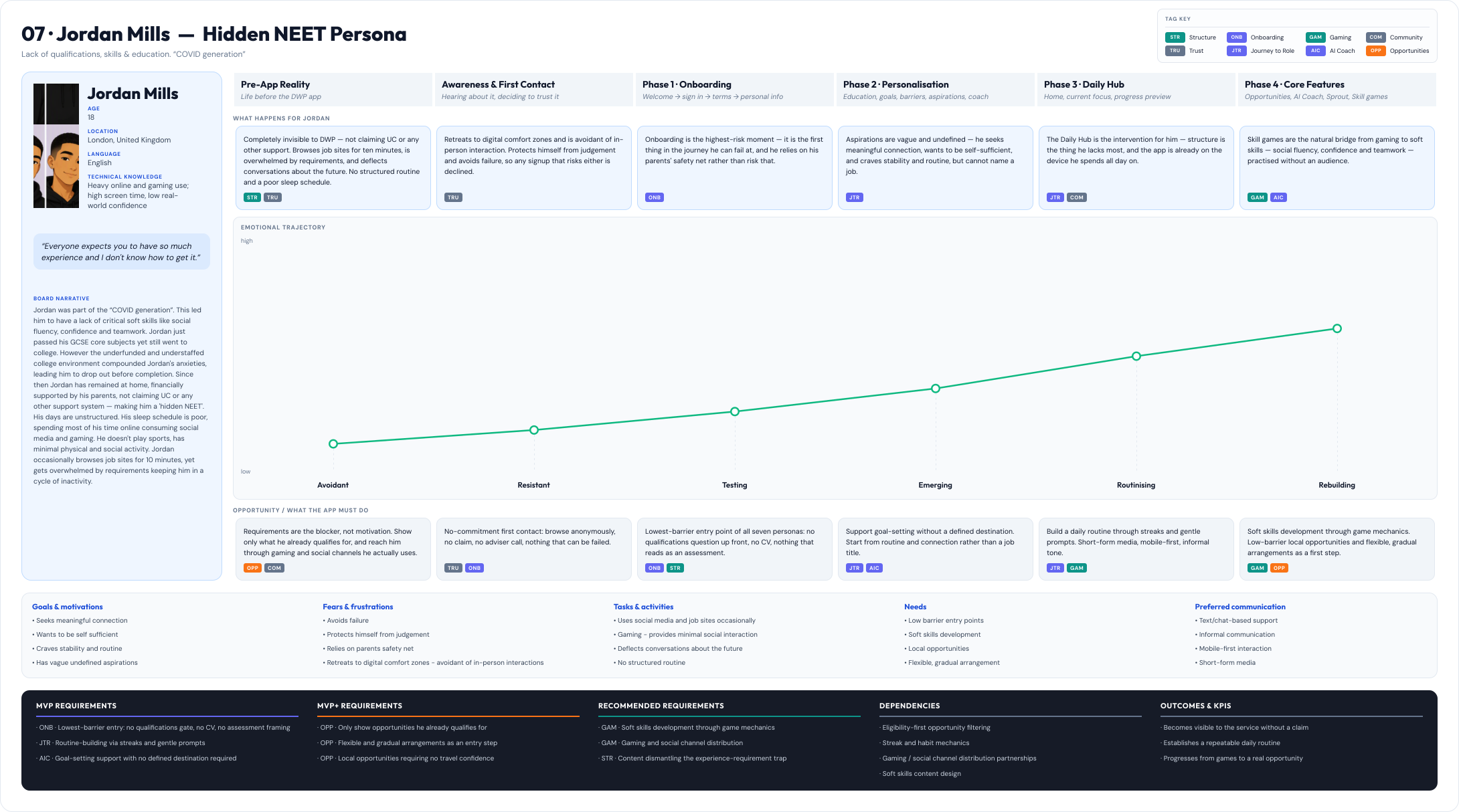
Click to view
An as-is journey map plotted what Jordan does, thinks, and feels across three phases - Pressure, Online Search, and Overwhelmed - surfacing pain points like lack of confidence, information overload, and no structured routine.
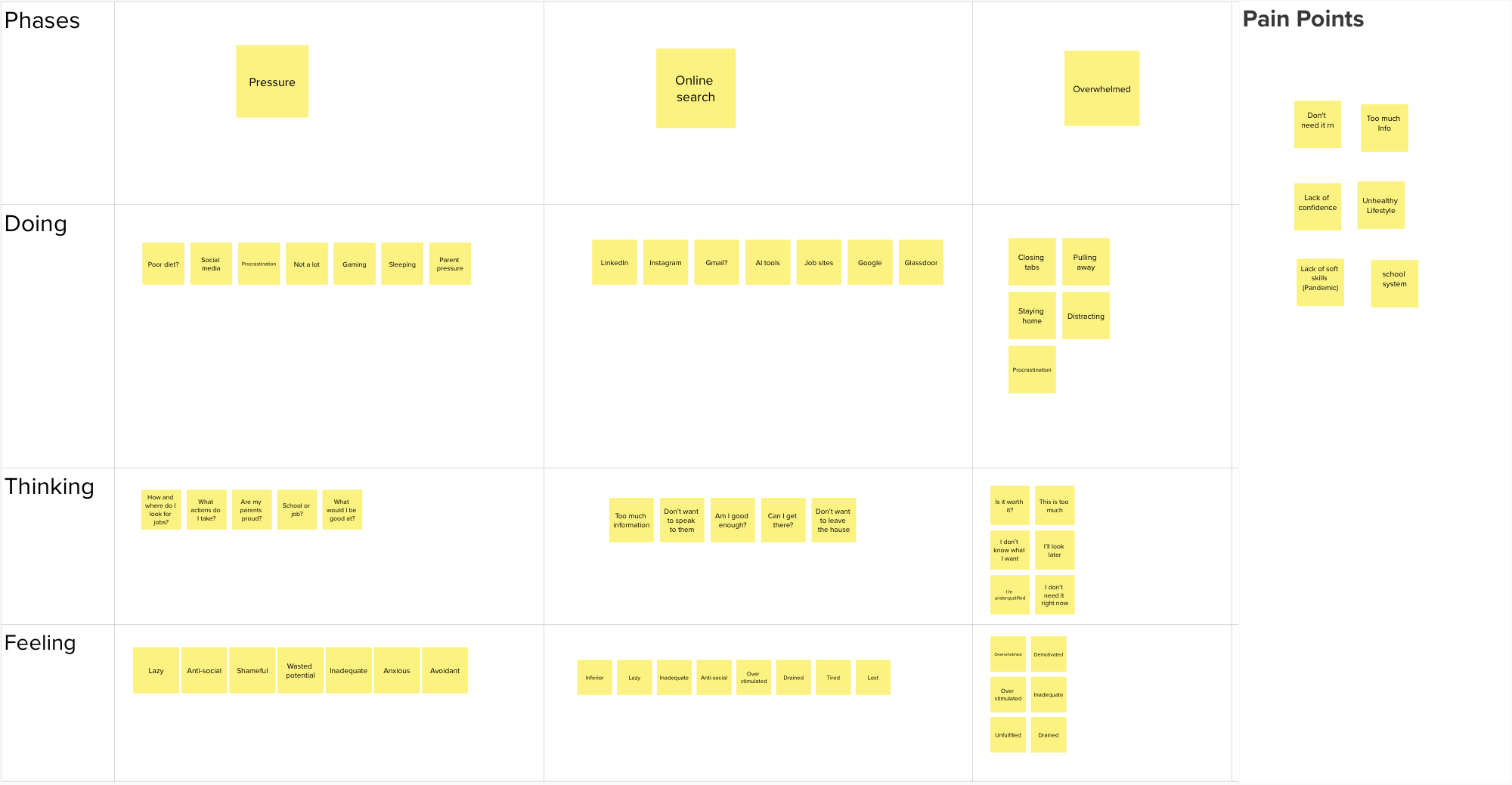
Click to view
Features
Turning research into features
Every core feature traces back to a specific research finding or persona need, rather than a generic mobile app pattern:
Onboarding
Sign-in and setup kept to the lowest-barrier entry point of all seven personas.
Why: onboarding is the first thing Jordan can fail at, so friction here risks losing him before he starts.
Personalisation
An 11-question flow on goals, barriers, aspirations, and coach choice, split across two phases.
Why: every persona starts from a different place - Helena's neurodivergence, Aaron's apprenticeship goal - so the app needs to adapt rather than assume.
AI Coach
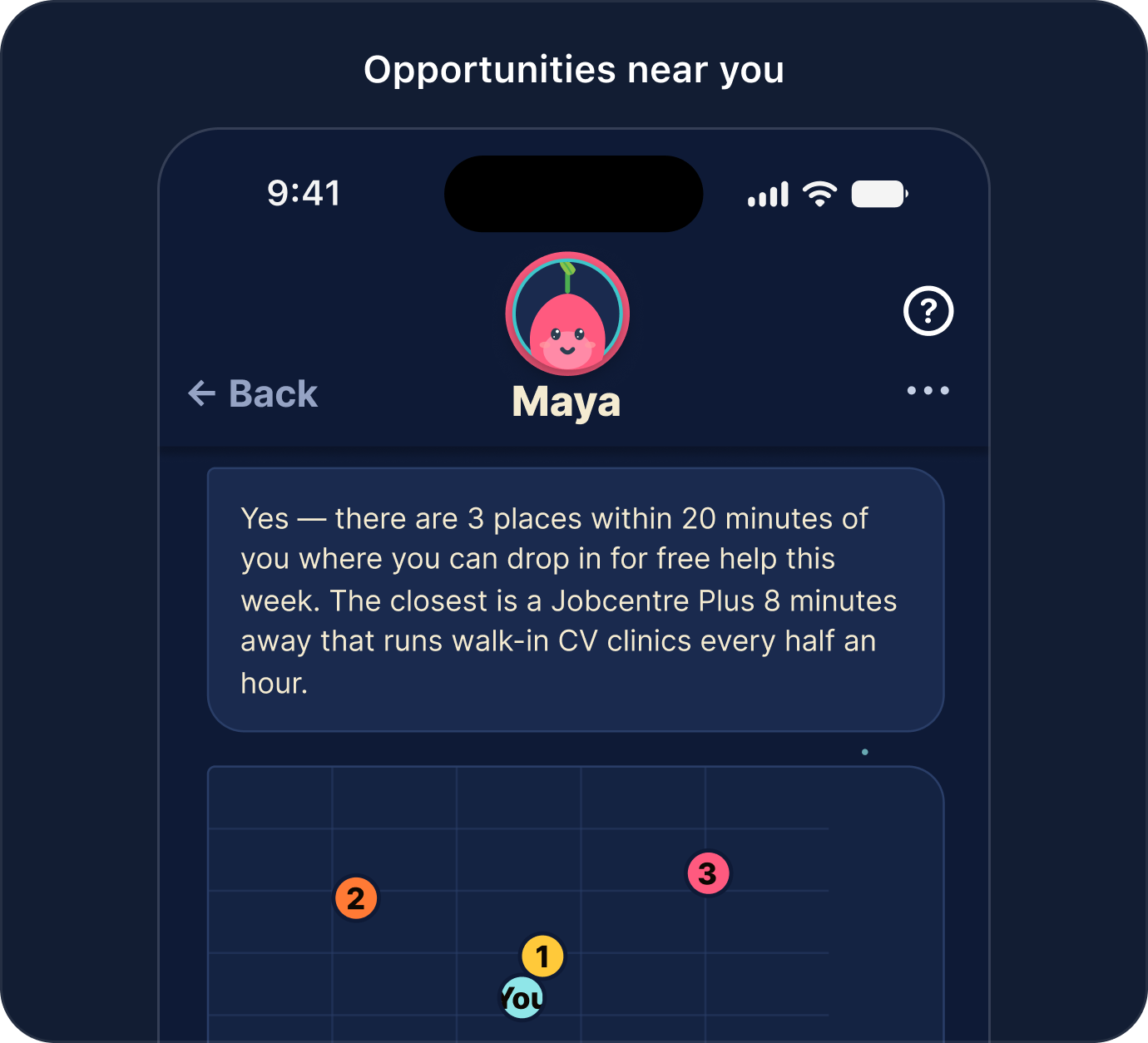
Four selectable coach personalities - Maya, Kai, Nova and Ori - each with a different tone. The coach also surfaces nearby in-person help, like a walk-in CV clinic a few minutes away.
Why: different people respond to different support styles, and the research kept pointing back to a real person, so the coach points towards one rather than replacing it.
CV builder
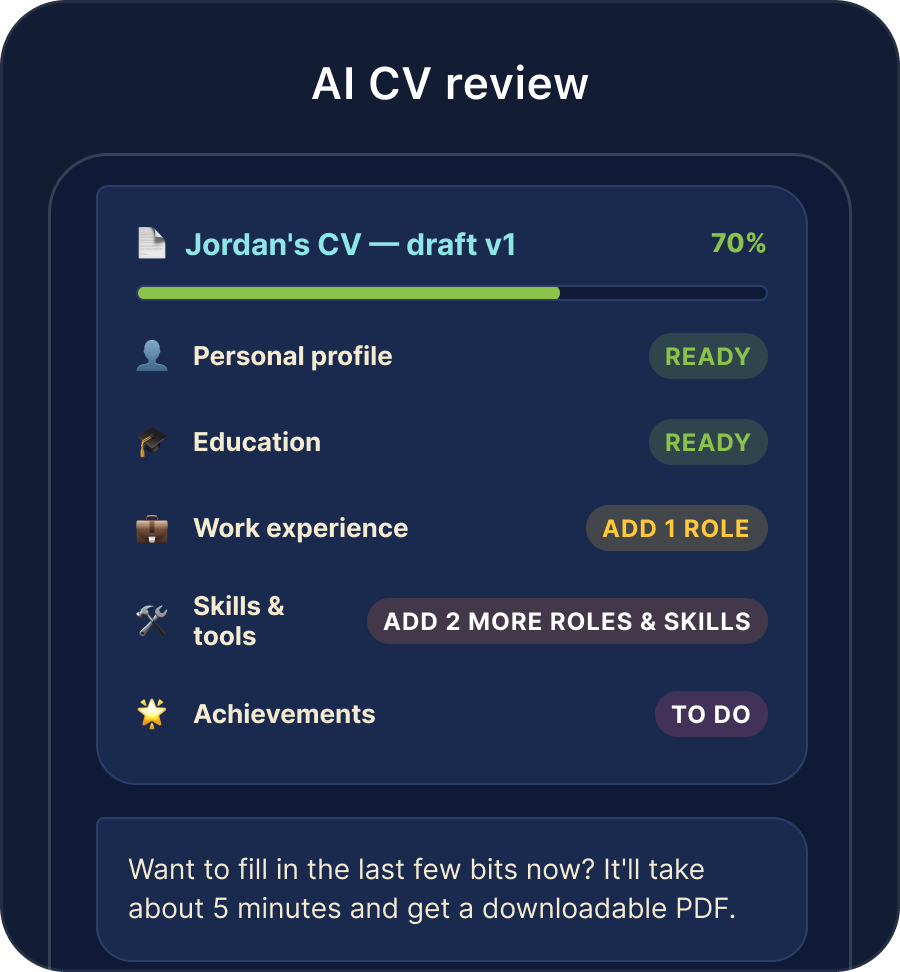
A guided CV builder that fills gaps section by section, shows a readiness score, and produces a downloadable PDF at the end.
Why: creating CVs and applications was one of the top three difficulties in the survey, and 67% of people were already using AI for it anyway.
Journey Tracker
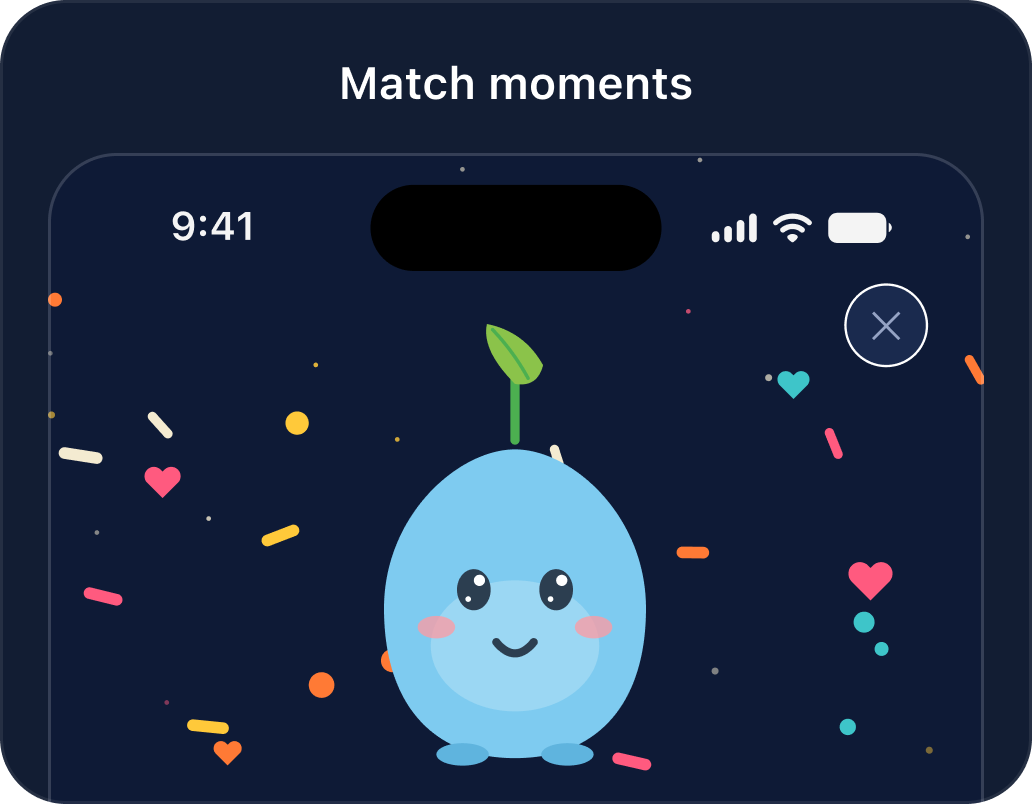
Progress framed as chapters on a path, with XP and streaks, and later chapters locked until the user is ready.
Why: answers "aspirations are vague and undefined" and the Milburn Report's call to treat participation as gradual, not immediate employment readiness.
Opportunity Board
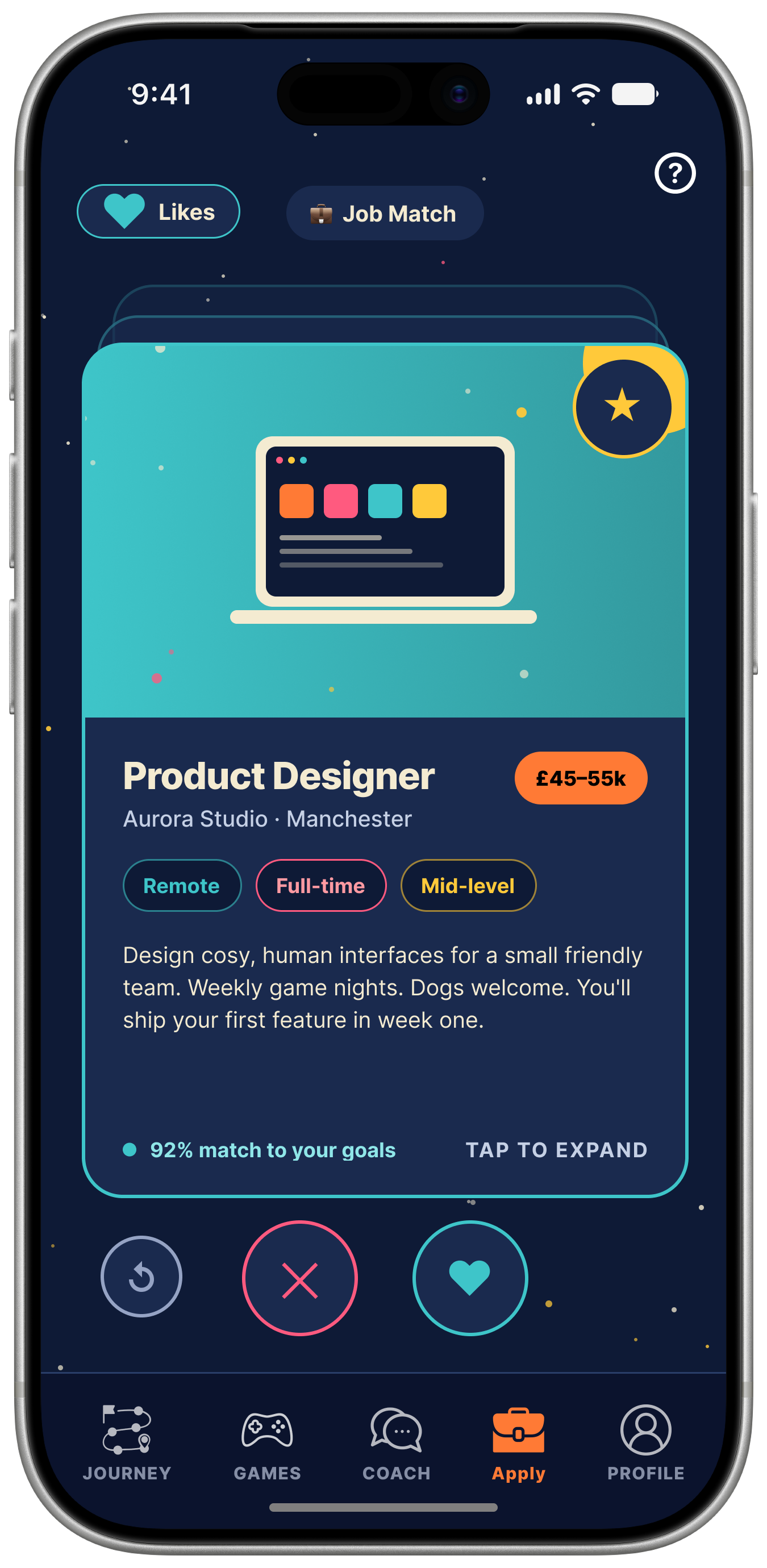
A swipeable Opportunity Board with a match score against the user's goals and skills.
Why: the NEET survey's top difficulty was finding the right opportunities; swiping and matching reduces the search itself to a low-effort action.
Games
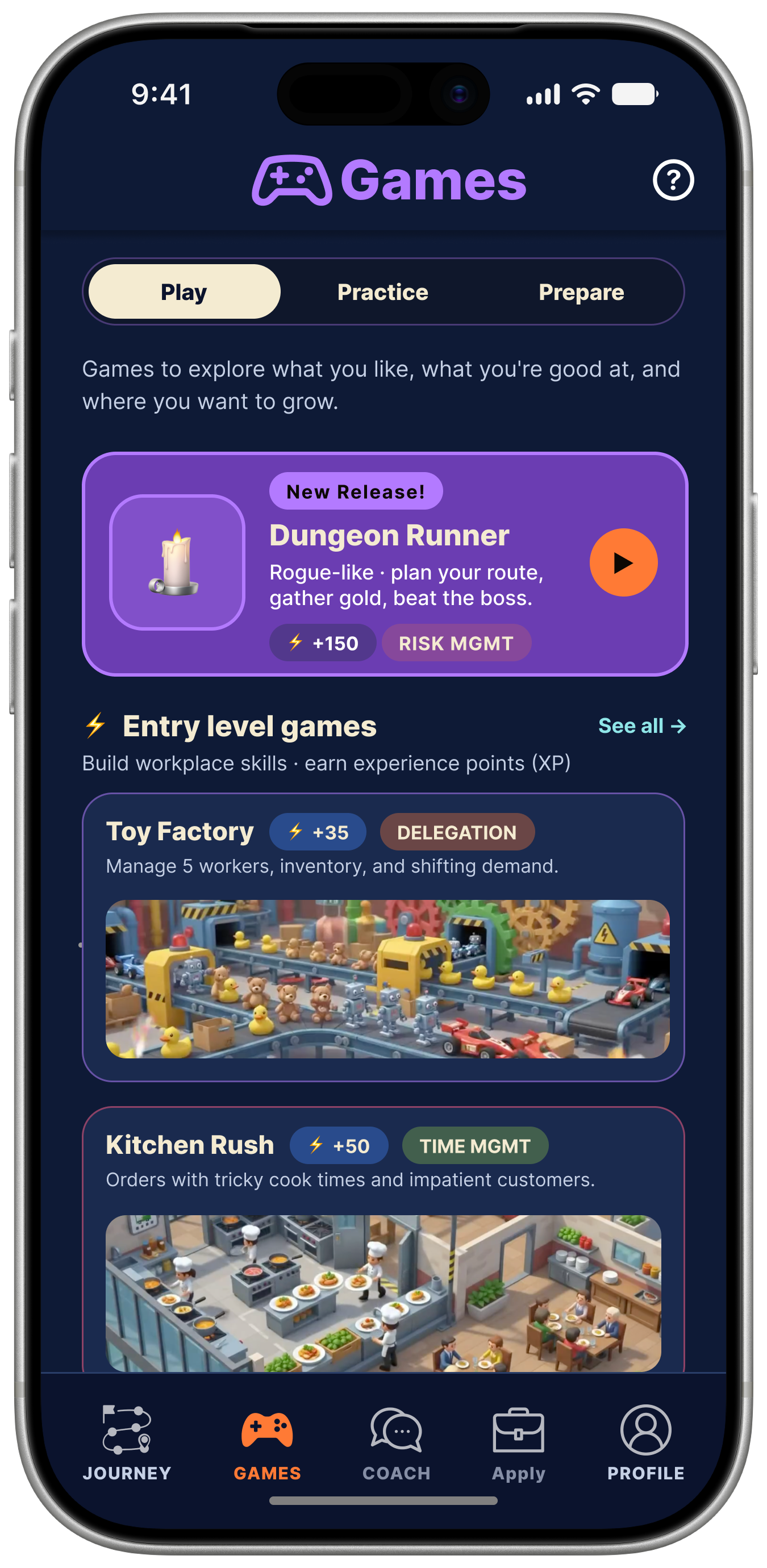
Skill-building games modelled on real workplace tasks, linked directly from job listings to the skills a role needs.
Why: answers Saif's bind of being overqualified yet underexperienced - a low-pressure way to build the specific skills a role is missing.
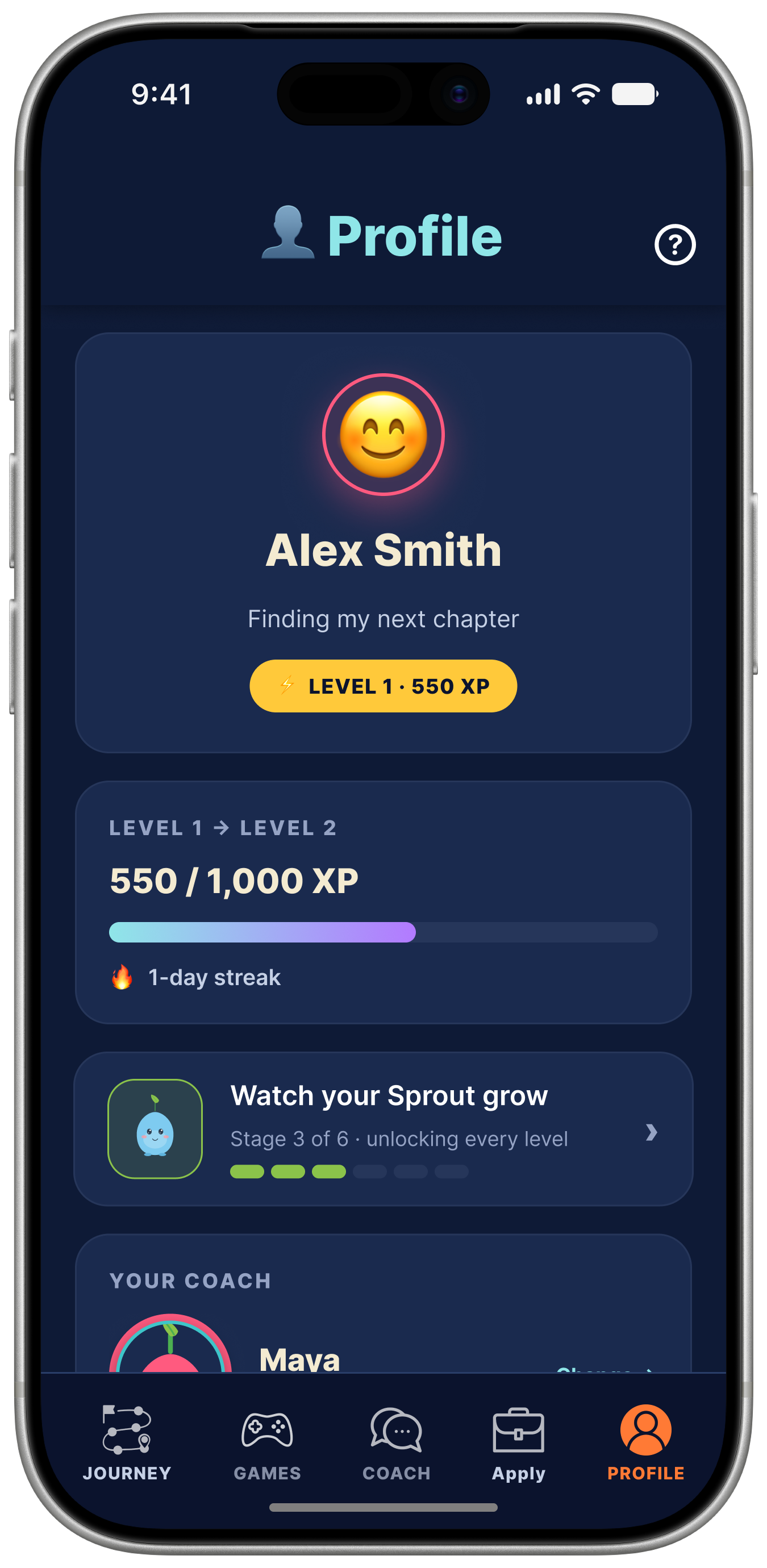
Sprout growth tracker
A visual growth tracker on the profile screen.
Why: makes gradual, non-linear progress visible - success isn't a binary employment outcome, it's growth over time.
My Contribution
What I owned on this project
I was the team's UX designer (Experience Designer, in IBM's job titles) in a five-person team: Amani Kohler (Product Manager), Murtaza Naqvi (Developer), Vasudha Goel (Business Analyst and Content Designer), Cal Prince (Scrum Master and Delivery Manager), and me. Working with a UK government department as the client, my responsibilities covered:
- Research: took part in jobcentre and youth hub observations and staff and student interviews, and built the persona and journey maps across all seven personas
- Design: owned the user journey flows and screen design across Onboarding, Personalisation, the Journey Tracker, Opportunity Board, AI Coach and Games, iterating the Figma prototype after each sprint
- Testing: co-facilitated usability sessions across two rounds, then fed findings into the MoSCoW-prioritised backlog
- Playback: helped prepare and present the weekly client playbacks throughout the internship, including the final showcase
Process
How the internship ran
Discover
Roughly two months of primary research: jobcentre and youth hub observations, interviews with frontline staff and students, and a NEET survey, plus desk research into the Milburn Report and ONS data.
Define
Thematic analysis into seven personas and journey maps, an app structured around four phases, and features prioritised with MoSCoW against each persona's needs.
Develop
Concepts explored as a team, then built into a full Figma prototype across the six core flows, with a deliberately calm, low-pressure visual language, iterated after each sprint.
Deliver
Two rounds of usability testing, every "must have" fix implemented, and weekly playbacks through to the final showcase.
Structure
Organised around small steps, not a to-do list
The app is built in four phases: Onboarding (welcome, sign in, terms, personal info kept to the lowest-barrier entry point of all seven personas), Personalisation (education, goals, barriers, aspirations, coach), the Journey Tracker (home, current focus, progress preview), and Core Features (Opportunity Board, AI Coach, Games, and Sprout - the growth tracker at the heart of the experience). Read another way, every feature answers one thing the user is asking for:
- Understand me - onboarding and profile
- Help me progress and grow - the journey, activities and games
- Help me act - the coach and jobs
- Connect me to people - Youth Hubs, Work Hubs and advisers
Rather than a flat task list, the Journey Tracker frames progress as chapters on a path - XP, streaks, and a progress bar make small steps like a "values check" or "skills assessment" feel like part of a bigger story, with later chapters locked until the user is ready for them.
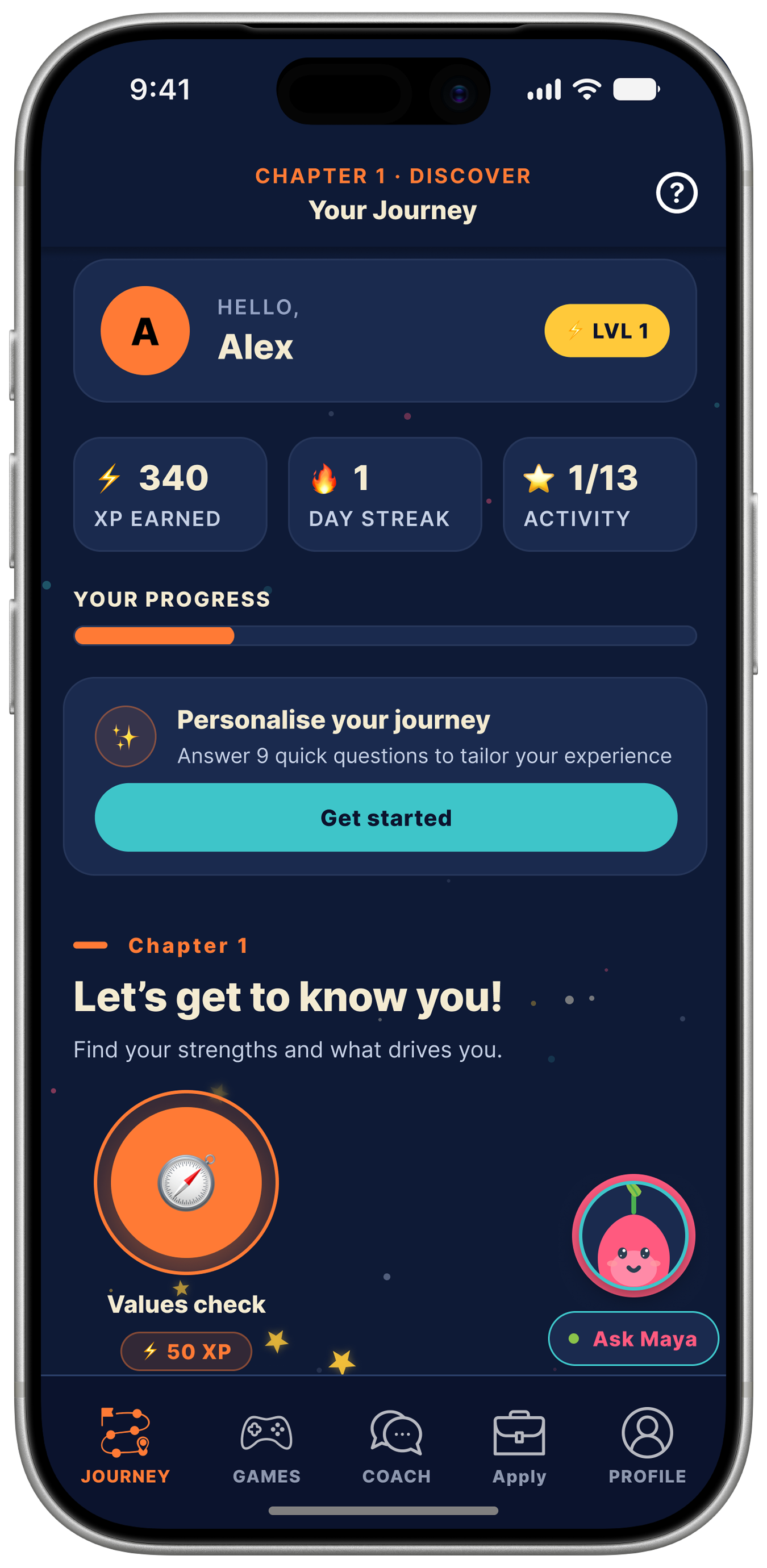
Click to view
The end-to-end flow
I mapped the product end to end - every screen, decision point and back-route - so the team had one reference for how the prototype behaves and I had a clear spec to design against. It runs from first launch through onboarding, personalisation and the home hub into each core feature.
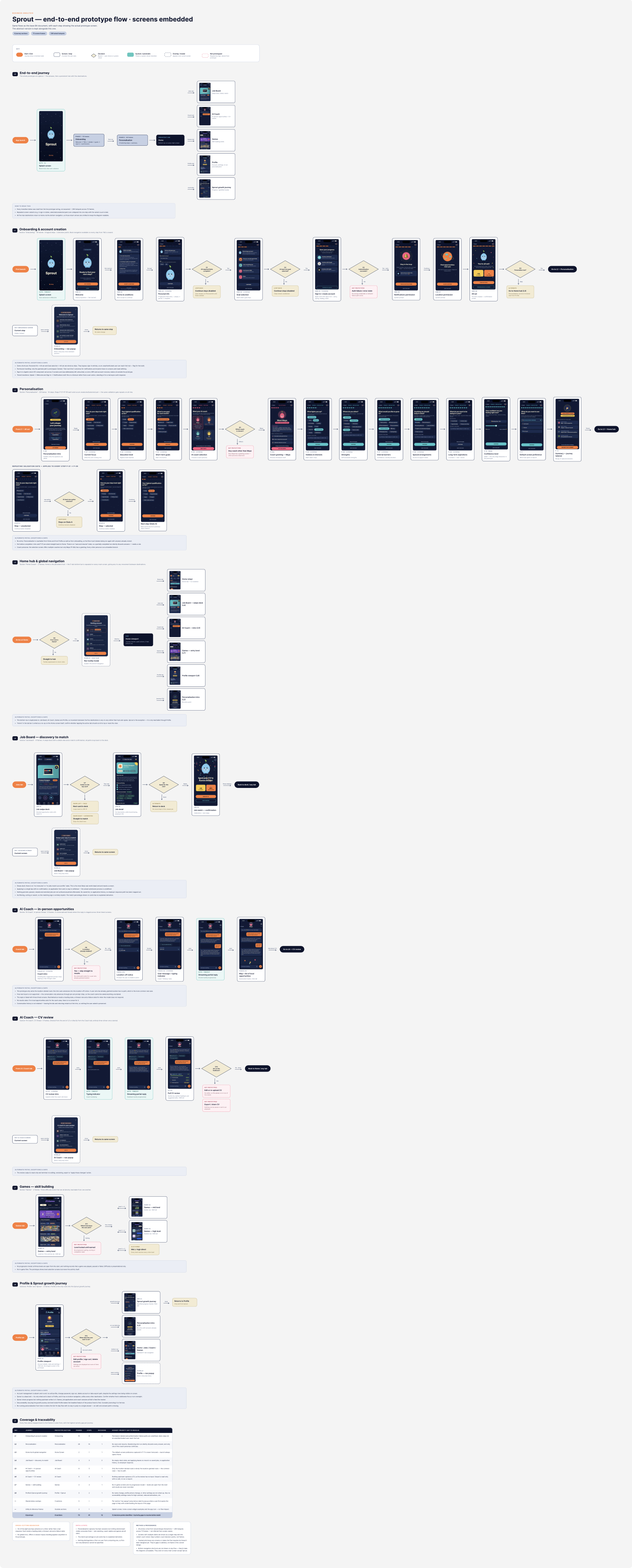 Open the full flow (PDF)
Opens in a new tab - zoom in to follow any path
Prototype
Personalisation, Opportunity Board, AI Coach and Games
We designed six core features, each shaped by specific research findings. Here's a tour through the most interactive ones: the personalisation flow that adapts to each persona's starting point, the Opportunity Board with swipe-to-match mechanics, an AI coach with four selectable personalities, and skill-building games modelled on real workplace tasks.
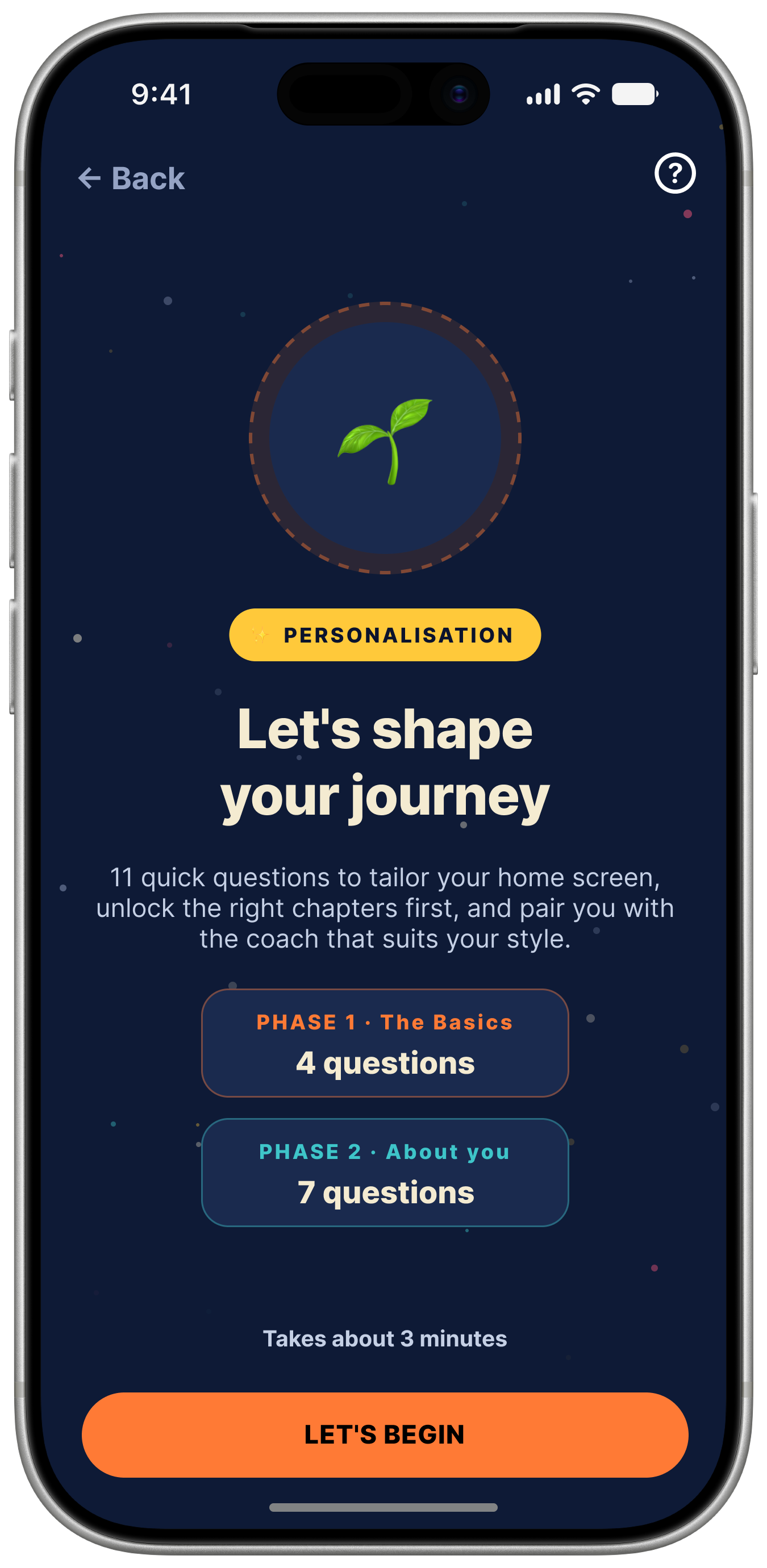
Click to view
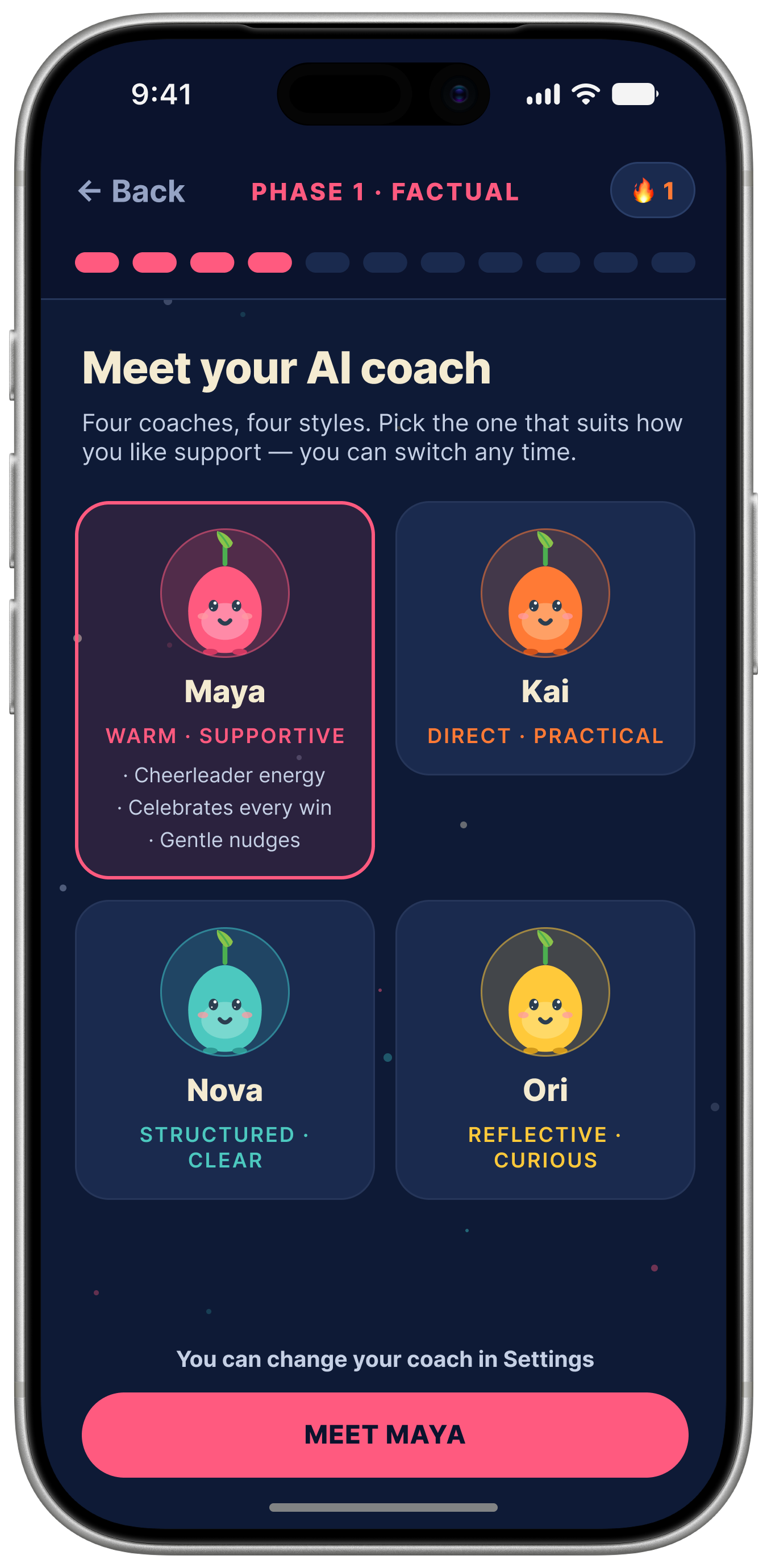
Click to view
Click to view
Click to view
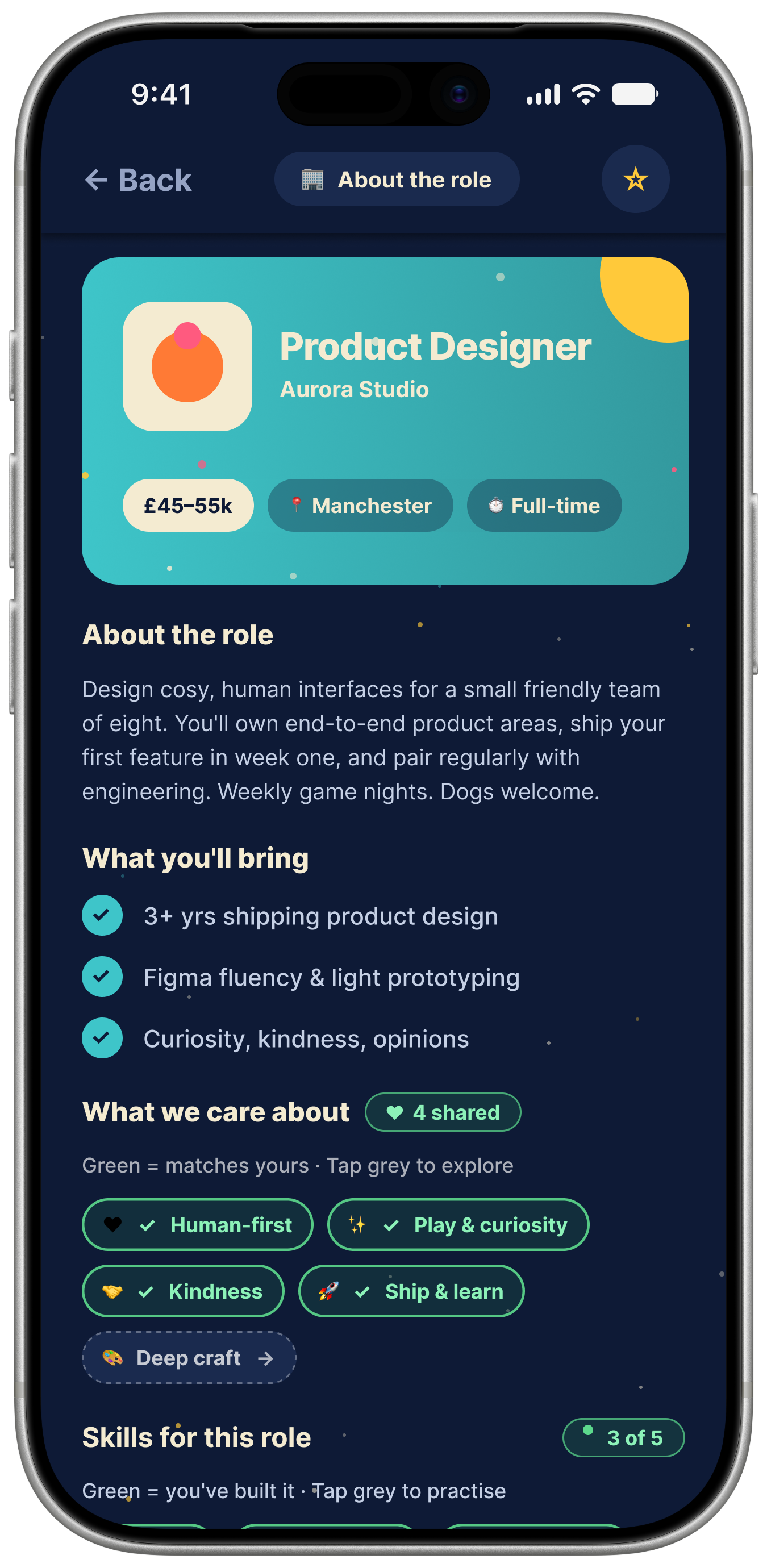
The job detail screen went furthest in connecting features together - showing exactly which skills a role needs, which of those the user already has, and a direct link to play the games that build the ones they're missing.
Click to view
Beyond the core loop
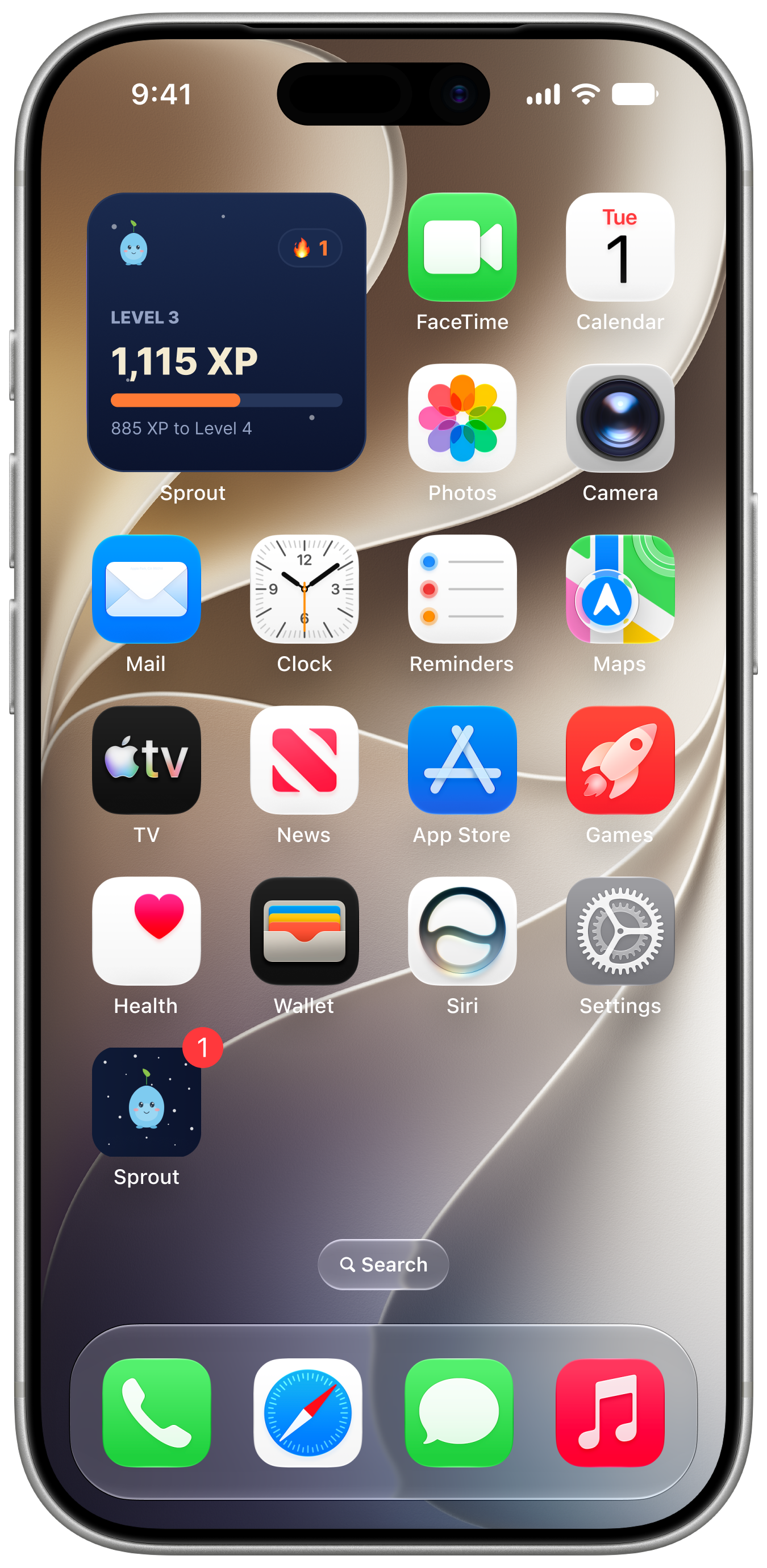
Three smaller pieces round out the experience: the coach surfaces in-person help nearby, the CV builder fills the gaps most people were stuck on, and a home-screen widget keeps progress glanceable so the app does not have to be opened to feel present.
Click to view
Click to view
Click to view
Click to view
Testing
Validating usability with real users
We conducted in-person usability testing in two rounds. The first, on 20 August 2026, had 8 participants: 6 young people (facilitated in pairs: I ran two with Cal, Amani and Murtaza ran the third) and 2 work coaches, who brought a frontline view on barriers and sensitive features. I observed navigation on handheld devices, asked probing questions about how the design felt, and recorded qualitative feedback to identify friction points.
Reception was enthusiastic. 91% of participants said they liked the gamification, and the feedback that stuck with us was less about features than feeling: "I feel safer here," "The colours are really cool and Sprout is really cute," and "When is it dropping?"
What stood out:
- Games were unanimously praised - "My sister would use this" - and stakeholders called them "absolutely brilliant"
- Opportunity Board was a standout: the swipe interface was described as "like Tinder" and "LOVE this," with the match score helping users trust the suggestions
- Onboarding was straightforward, with no significant barriers to entry identified
- Personalisation was harder to find - 8+ instances of users needing prompting to locate it, and confusion over words like "win" and "XP"
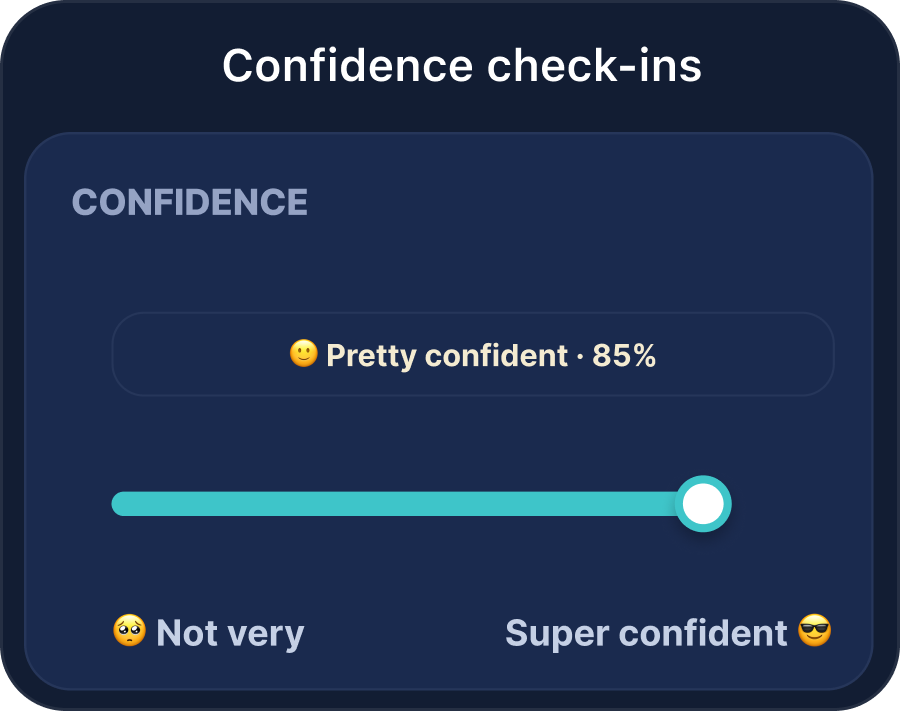
- The work coaches singled out the Sprout growth visual as "cute," with one comparing it to a tamagotchi, and suggested adding a confidence gauge
- The visual design was praised for not looking like a government product - more welcoming and less institutional than participants expected
I then implemented every "must have" fix directly into Figma: personalisation discoverability, clearer terminology, skip and multi-select options, and the new confidence gauge. We ran a second round with 3 young people outside the youth hub to verify the fixes worked as intended.
Results
From feedback to shipped fixes
Every "must have" recommendation from testing was implemented: the personalisation entry point is more prominent, confusing terms like "win" were reworded, questions can be skipped or multi-selected, and a confidence check-in now sits on the profile alongside the Sprout growth tracker - directly answering the work coaches' suggestion to help users "see progress with it."
Click to view
Click to view
Testing validated the core concept: young people found it engaging and non-patronising, and stakeholders saw a credible path to reducing NEET numbers by meeting young people like Jordan where they already are - on their phone, at their own pace.
We presented Sprout to the Government Digital Service (GDS), the Department for Science, Innovation and Technology (DSIT), and Andrew Western, Minister for Employment.
Where it stands now
Proof of concept done, development underway
The internship ended with a tested Figma prototype and a complete design system, every feature finalised and flow fully specified. Since handover, our developer has moved into building: onboarding, personalisation and the journey tracker are already in code, with the Opportunity Board and Games to follow. The build pulls from the client's live services, so opportunities in the app link directly to existing job-search frameworks rather than a separate database.
Product roadmap
Now · developed
Introduce
Profile setup, help categorisation, notifications and location sharing. Insight into the app without a long first engagement.
Track personalised progress
Journey Tracker with chapters by status, the aspirations questionnaire, and AI coach selection. Meets each young person where they actually are.
Provide coaching
A direct messaging interface with status updates on growth. An informal route in for people who avoid formal systems.
Next · prototyped
Highlight opportunities
The swipe-to-match Opportunity Board with a details page for skills and values, and quick apply. Applications made accessible with minimal data entry.
Build skills through games
Games targeting specific skills, multiple levels, and SkillsBuild integration. Skill building that engages harder-to-reach individuals.
Later · opportunities
Support structurally limited young people
Acknowledge financial, transport and housing barriers, and integrate training on support networks.
Connect to wider services
Link the profile to benefits systems, push live updates to work coaches, and connect the full support offer available to each young person.
We are not asking young people to believe in themselves before they start. We are building a safe way for them to start small, make progress, and prove that they can.